Monday, August 9, 2010

NORTH KOREA About 23 Christians arrested, 3 executed

6th August 2010 – Asia News

Seoul (AsiaNews) – North Korea’s Stalinist regime has discovered some underground Christians in a house church in Pyongan Province. All 23 who met to celebrate a religious function were arrested. Three were tried and given the death penalty, which was swiftly executed, sources told AsiaNews. Confirmation about the incident also came from the North Korea Intellectual Solidarity, a group of North Korean exiles.

According to the sources, the arrests and executions were carried out in mid-May. “At that time, right after the disastrous currency reform, police discovered 23 Christians in Kuwal-dong, Pyungsung County, in Pyongan Province, who met at an underground church. After their arrest, they were interrogated at length. Eventually, the group’s “ringleaders” were sentenced to death and executed. The others were sent to Kwan-li-so (Penal labour colony) No 15 in Yodŏk.”

These North Koreans discovered underground Christianity when some of them travelled to mainland China for work.

“As the authorities fear the spread of religion, many area residents are rounded up and interrogated for days,” the sources said. However, “they cannot help it because the situation is so desperate that people are going back to religion. Such sentences are meant to scare people.”

North Korea denies freedom of religion absolutely. Officially, the country has three Christian places of worship (one Catholic and two Protestant churches) and four Buddhist temples, but only in the capital Pyongyang. No one has been able to confirm how many exist in the rest of the country. Accounts about their number by foreigners who have travelled around the country vary.

The only cult allowed is that of ‘Eternal President’ Kim Il-sung and his son, the ‘Dear Leader’ Kim Jong-il.

After the Korean War in 1953, the Stalinist regime ruthlessly proceeded to kill the country’s estimated 200,000 Catholics, and destroy their churches and abbeys.

Sources have told AsiaNews that in North Korea there are “no more than 200 Catholics left, all very old”.

NORTH KOREA About 23 Christians arrested, 3 executed - Asia News

Saturday, August 7, 2010

Scientific Fundamentalism?

August 2010 – Word on Fire Blog.

Robert Mixa responds to Lawrence Krauss's recent article in Scientific American which makes the popular claim that religion and science are at odds. Read below for Mixa's fact-filled rebuttal.


The myth that science and religion are irreconcilable is a hardy perennial among contemporary “intellectuals.” Lawrence Krauss’s recent article in Scientific American (“Faith and Foolishness,” August, 2010) is just one more example of the trend.
Dismayed by the perpetuation of this myth, I sent a link of the article to my friend, who is working on his PhD in philosophy. Since his dissertation research deals extensively with the philosophy of science, he was able to give me a lot of insight into the problems with Krauss’s argument.
As we discussed the article, we began to realize that Krauss’s construal of all religion as fundamentalism is, in fact, itself a fundamentalism which is not capable of understanding the unique Catholic synthesis of Faith and Reason, and which arrives at its anti-religious conclusions through selective use of evidence.

Continue reading at Fr. Robert Barron's Word On Fire - Culture: Faith and Foolishness?

Friday, August 6, 2010

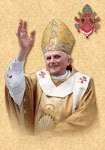
Pope Benedict wanted to be a librarian

August 2010, Telegraph.

His predecessor, Pope John Paul II, declined his request to spend his last years as the archivist of the Vatican Secret Archives and as a librarian of the Vatican Library, according to the incumbent librarian and archivist Cardinal Raffaele Farina.

Speaking in Inside the Vatican magazine, Cardinal Farina recalled when he was appointed prefect of the Vatican Library in May 1997 he had a brief meeting with Cardinal Ratzinger in which he was asked his own opinion of the future pope joining the team.

At the time the future Pope Benedict was Cardinal Joseph Ratzinger, the prefect of the Vatican’s Congregation for the Doctrine of the Faith, the Pope’s doctrinal enforcer.

But he found his job “burdensome” and wanted to retire to academic study of ancient documents for the rest of his life.

He asked the Pope if he could step down from his role when he turned 70 on April 16, 1997, a move which would have permanently removed him from Vatican politics and from the eyes of the world.

Continue reading - Pope Benedict wanted to be a librarian - Telegraph

Atheist Guru repeats his lies.

4th August 2010, Damian Thompson, Telegraph.
Vanity Fair have sent me a preview of Christopher Hitchens’s very unpleasant piece about his cancer – unpleasant not just because Hitchens describes in detail the invasion of his body by a monstrous tumour, but also because it contains a despicable slur against the Pope. (And Henry Kissinger, but I don’t care about that.)
He writes: “Will I really not live long enough … to read – if not indeed write – the obituaries of elderly criminals like Henry Kissinger and Joseph Ratzinger?”
This should scarcely need saying, but Pope Benedict XVI is not a criminal: neither Hitchens nor anyone else has produced evidence that he covered up the crimes of paedophile priests. On the contrary, he sought to tighten up canonical procedures against sex abusers. There were plenty of cover-ups; it’s just that the former Prefect of the Congregation for the Doctrine of the Faith didn’t organise them and, indeed, fought battles with some of those prelates who did.
Continue reading Christopher Hitchens: I'm sorry that I probably won't live to see the death of 'elderly criminal' Benedict XVI – Telegraph Blogs

UPDATE
Vanity Fair recants: Pope not an elderly criminal just an elderly villian.

Fr Robert Barron comments on Christopher Hitchens at "Word on Fire".

Tuesday, August 3, 2010

Politics: A Decade Later: Time for a Dose of Reality on Stem Cells

August 2010. Catholic News Agency (CNA)

By Richard Doerflinger

In 1998, Dr. James Thomson of the University of Wisconsin first isolated human embryonic stem cells (ESCs). These early, unspecialized cells were hailed as a way to create all cell types of the human body at will, a Holy Grail for curing diseases. Moral qualms about killing embryos for the cells were swept away in this wave of enthusiasm. In a few years, it was said, life-saving medical advances would show that such objections should be ignored.

A decade later, it is time for a reality check. ESCs have been involved in some interesting experiments, but are not close to producing cures. This is not due to limited federal funding—it is equally true in countries with no such limits, and in states pouring their own public funds into the research. ESCs in fact are unpredictable, difficult to control, and prone to causing tumors in animals. Experts now admit that human treatments using them may not emerge for decades, if ever.

The bishops’ statement Forming Consciences for Faithful Citizenship urges Catholics to become informed on important moral issues in public life, including this issue of destroying embryos for stem cell research.

Continue reading - A Decade Later: Time for a Dose of Reality on Stem Cells :: Catholic News Agency (CNA)

Monday, August 2, 2010

Priests Commit No More Abuse Than Other Males - Newsweek

8th April 2010

The priesthood is being cast as the refuge of pederasts. In fact, priests seem to abuse children at the same rate as everyone else.

The Catholic sex-abuse stories emerging every day suggest that Catholics have a much bigger problem with child molestation than other denominations and the general population. Many point to peculiarities of the Catholic Church (its celibacy rules for priests, its insular hierarchy, its exclusion of women) to infer that there's something particularly pernicious about Catholic clerics that predisposes them to these horrific acts. It's no wonder that, back in 2002—when the last Catholic sex-abuse scandal was making headlines—a Wall Street Journal-NBC News poll found that 64 percent of those queried thought Catholic priests "frequently'' abused children.

Yet experts say there's simply no data to support the claim at all. No formal comparative study has ever broken down child sexual abuse by denomination, and only the Catholic Church has released detailed data about its own. But based on the surveys and studies conducted by different denominations over the past 30 years, experts who study child abuse say they see little reason to conclude that sexual abuse is mostly a Catholic issue. "We don't see the Catholic Church as a hotbed of this or a place that has a bigger problem than anyone else," said Ernie Allen, president of the National Center for Missing and Exploited Children. "I can tell you without hesitation that we have seen cases in many religious settings, from traveling evangelists to mainstream ministers to rabbis and others."

Continue reading Priests Commit No More Abuse Than Other Males - Newsweek

Book Review: Cracks in the Crescent - Islamic Contradictions

By Philip Blosser
Philip Blosser is Professor of Philosophy at Sacred Heart Major Sem­inary in Detroit, Michigan.
Cracks in the Crescent.  By Hussein Hajji Wario. Bethany Press. 252 pages. $24.95.
Since the events of 9/11, Christians in the West have become increasingly interested in what makes the Muslim world tick. Writers and publishers, for their part, have begun turning out a growing number of books introducing Western Christians to the world of Islam. Offerings from Catholic publishers include Jacques Jomier's The Bible and the Qur'an (Ignatius Press, 2002), Dan­iel Ali and Robert Spen­cer's Inside Islam: A Guide for Catholics (Ascension Press, 2003); Spen­cer's Islam Unveiled (Encounter Books, 2003), and Giorgio Pao­lucci and Ca­mille Eid's interview-based volume, 111 Questions on Islam: Samir Kha­lil Samir, S.J., on Islam and the West (Ignatius Press, 2008), to mention but a few.
Hussein Hajji Wario's Cracks in the Crescent warrants special notice. Two facts set this book apart. First, Wario is not only a former Sunni Muslim with years of experience in an Islamic culture, but unlike many Muslims was thoroughly educated in the esoteric aspects of Islam. Second, the arguments he uses to expose Islam — arguments honed by years of experience of debating Muslim peers after his Christian conversion — are drawn from the extensive literature of Islam itself, not merely the Qur'an, but Islamic history, Seerah (the life of Muham­mad), Sunnah (specific words, actions, and practices of Mu­hammad), and Hadith (narrations based on the words of Muhammad shedding light on the Qur'an and matters of jurisprudence), and Fiqh (Islamic jurisprudence). The purpose of his book, Wario says, is to help both Muslims and non-Muslims seeking answers about the true nature of Islam.
Continue reading at New Oxford Review