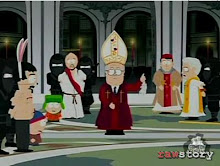
Embryonic Stem Cell Researchers combine poetry, scripture, and stupidity so as to make themselves feel good about themselves. Somebody should tell them that whilst Jesus willingly gave up his life for the benefit of others, the human embryos killed for their stem cells don't... their life is extinguished by researchers.
Stem C.
By Tyson Anderson
This is my body
which is given for you.
But I am not great.
I have neither wealth,
nor fame, nor grace.
I cannot comfort with words,
nor inspire to march.
I am small and simple,
so leave me this.
Let me heal you.
This is my body
which is given for you.
Take this
in remembrance of me.
Read more at Mary Meets Dolly.
Showing posts with label Stem Cells. Show all posts
Showing posts with label Stem Cells. Show all posts
Friday, December 3, 2010


Friday, October 8, 2010
Revisiting Geoffrey Robertson’s plan to arrest the Pope
Should the Pope be tried for crimes against humanity?
Mercator Net, Michael Cook | Friday, 9 April 2010
A United Nations jurist wants to put Benedict XVI in the dock for condoning sex-abuse. The real question is, how many others should be there with him?
A prominent Australian-British human rights lawyer and United Nations jurist has suggested that the Pope be put on trial for crimes against humanity. I think that this is a brilliant idea.
Geoffrey Robertson outlined his scheme in The Guardian and a number of Australian newspapers. Although he feels strongly that the Vatican is fraudulently representing itself as an independent country, the Pope should be brought to account for systematic abuse of human rights during his pontificate. Since 2002, he points out, heads of state are no longer immune from prosecution before the International Criminal Court. For instance, a warrant has been issued for the arrest of the president of the Sudan, Omar al-Bashir, for crimes against humanity and war crimes.
In Pope Benedict’s case, Robertson argues that this includes sexual abuse of minors:
Continue reading at MercatorNet: Should the Pope be tried for crimes against humanity?
If you are interested in reading more, please check out MercatorNet's focus blog on the sexual abuse crisis -- Just B16
Monday, October 4, 2010
Good news for Catholic Bioethics:
Researchers pioneer new method to generate non-embryonic stem cells
Boston, Mass., Oct 1, 2010 / 07:03 am (CNA).-Continue reading Researchers pioneer new method to generate non-embryonic stem cells :: Catholic News Agency (CNA)In what one expert calls a “major paper,” researchers have reported new advances in creating efficient and safe alternatives to human embryonic stem cells.
A team led by Derrick J. Rossi of the Children’s Hospital Boston used laboratory-made versions of natural biological signals to quickly convert ordinary skin cells into cells that appear virtually identical to embryonic stem cells. They can then coax these cells to change into specific tissues that would be a match for transplantation into patients, the Washington Post reports

Friday, August 27, 2010
Embryonic Stem Cell Researchers Promise Everything but Deliver Nothing
By Diogenes | August 24, 2010 Catholic Culture
Read all the mainstream-media coverage of Judge Royce Lamberth’s decision to stop federal funding for embryonic stem-cell research, and you may notice that two major themes emerge. Neither theme is inaccurate, yet both are misleading.
First, the conventional accounts remind readers that embryonic stem-cell research (ESCR) has great potential.
It is “promising but controversial research,” says the Wall Street Journal. It is a “promising new science,” Time magazine agrees. Scientists “hope to be able to use” ESCR to treat many diseases, Reuters reports. The Los Angeles Times cites a White House spokesman who said judge’s decision “carries the potential to block ‘critical, life-saving research.’" [My emphasis throughout]
Promise... promising… potential…hope. What you don’t see, in all those news accounts, is a report that scientists have used ESCR successfully to treat diseases, or are using ESCR in clinical settings right now. You don’t even read about successful ESCR experiments that could soon lead to medical breakthroughs.
Continue reading at Catholic Culture : Off the Record : promise them anything
Tuesday, August 3, 2010
Politics: A Decade Later: Time for a Dose of Reality on Stem Cells
August 2010. Catholic News Agency (CNA)
By Richard Doerflinger
In 1998, Dr. James Thomson of the University of Wisconsin first isolated human embryonic stem cells (ESCs). These early, unspecialized cells were hailed as a way to create all cell types of the human body at will, a Holy Grail for curing diseases. Moral qualms about killing embryos for the cells were swept away in this wave of enthusiasm. In a few years, it was said, life-saving medical advances would show that such objections should be ignored.
A decade later, it is time for a reality check. ESCs have been involved in some interesting experiments, but are not close to producing cures. This is not due to limited federal funding—it is equally true in countries with no such limits, and in states pouring their own public funds into the research. ESCs in fact are unpredictable, difficult to control, and prone to causing tumors in animals. Experts now admit that human treatments using them may not emerge for decades, if ever.
The bishops’ statement Forming Consciences for Faithful Citizenship urges Catholics to become informed on important moral issues in public life, including this issue of destroying embryos for stem cell research.
Friday, July 9, 2010
Leading stem cell scientist quietly drops embryonic work
by Michael Cook | 3 Jul 2010
Amongst scientists who promoted the use of human embryonic stem cells five years ago, in the middle of passionate debates in the US, Australia and elsewhere, few were more influential in shaping the ethical debate than Harvard’s George Q. Daley. “We must support the vitally important applications of embryonic stem cells to medical research,” he testified to a Congressional committee in 2005.
He contended that work on hESCs was so important that it could not be delayed. It was needed for cures, drug development and genetic research. The fact that years had passed without results made no difference. “The field of human embryonic stem cell research is a mere 7 years old, so it is premature to expect successful cell therapies to have already been delivered to patients.”
Now, he has transferred the same sense of urgency and excitement to an ethical non-controversial alternative to hESC research which he dismissed before the committee – induced pluripotent stem cells (iPS cells). At the time, he said, “Although this strategy is worth pursuing, it is extremely high-risk, and may take years to perfect, and may never work as well as nuclear transfer, which we know we can practice today.”
However, in 2007 iPS cells were developed by Shinya Yamanaka. Professor Daley immediately stopped campaigning for hESCs. In an interview with Nature Medicine, he says, “Once Yamanaka solved the problem, I turned around virtually my entire program to take advantage of that breakthrough.”
In language remarkably similar to his 2005 testimony, he now promotes iPS cells: “There's no reason in my mind to think that we're not going to have iPS cells that function as well as embryonic stem cells.” Why haven’t there been any cures yet? “You can't hold the field to too high a standard. It's only been two years, and a lot of this stuff is in the pipeline.” ~ Nature Medicine, June
Continue reading at BioEdge: Leading stem cell scientist quietly drops embryonic work
Subscribe to:
Posts (Atom)